


Trump and Assange: Pardoning, Plea Deals and Political Procurement
- jamesekin
- Sep 25, 2020
- 4 min read
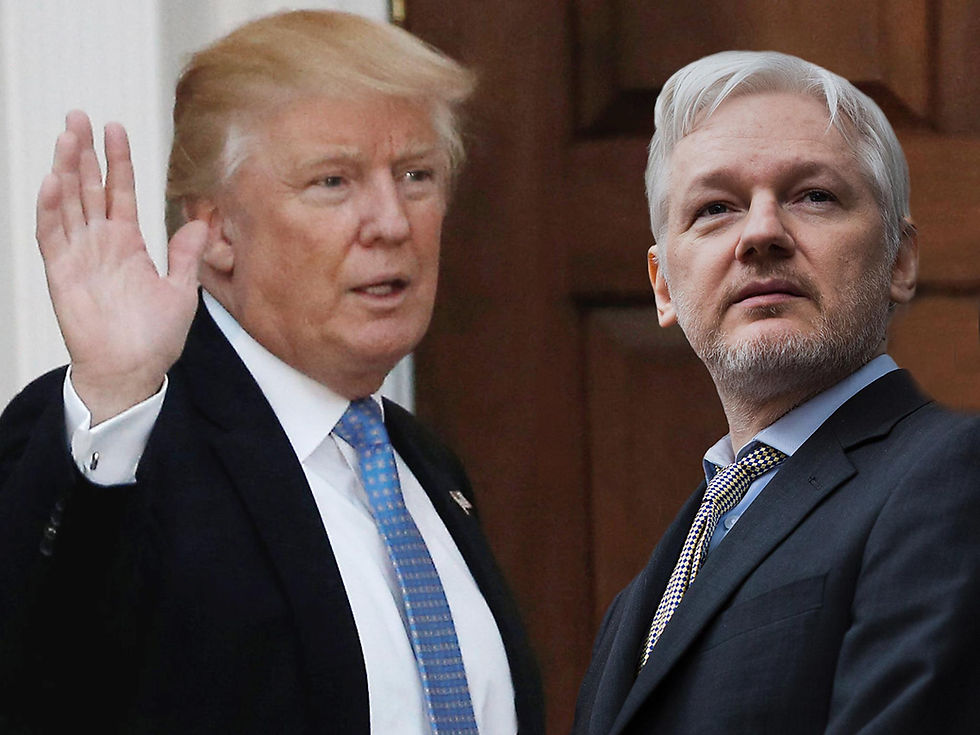
Australian-born Julian Assange, 49, is fighting to avoid being sent to the United States, where he is charged with conspiring to hack government computers and violating an espionage law over the release of confidential information by WikiLeaks in 2010-2011. Mr Assange, who is the co-founder of WikiLeaks, was a resident of the Ecuadorian Embassy for seven years, where he sought refuge after entering on 19 June 2012. Assange claimed diplomatic asylum after being wanted by Swedish authorities for questioning over four alleged sexual offences.
In April 2019 Mr Assange was arrested at the Ecuadorian Embassy, having claimed asylum in the building for seven years to avoid extradition to Sweden over sex offence allegations - which he has always denied. Sweden has since dropped its investigation into Mr Assange because of the length of the time which has passed from the time at which the claims were first made, but he still faces a string of charges in the US.
On the 11th of April last year (2019) Metropolitan Police arrested the Wiki Leaks co-founder on a warrant "issued by Westminster Magistrates' Court on 29 June 2012, for failing to surrender to the court" according to Scotland Yard.
However, in recent developments Assange has been appearing in Westminster Magistrates Court in the latest extradition hearing, in a series of legal battles faced by Assange, since the leaks by the company he co-founded a decade ago. Assange’s barrister, Jennifer Robinson, said in a witness statement to the court, that she observed a meeting at the Ecuadorian embassy in London in 2017 between Assange and then Republican U.S. Representative Dana Rohrabacher. She said Rohrabacher and an assistant offered to arrange a pardon for Assange in return for information about the hacking of Democratic emails before the 2016 U.S. presidential election.
“The proposal put forward by Congressman Rohrabacher was that Mr. Assange identify the source for the 2016 election publications in return for some form of pardon, assurance or agreement, which would both benefit President Trump politically and prevent U.S. indictment and extradition,” — Robinson said.
The US Government’s lawyer Eric Lewis asserted: "WikiLeaks and Mr Assange pose a threat to the legitimacy of Trump's (election) campaign that he is desperate to squash by diverting attention and imprisoning Mr Assange”. It is thought that the US attorney general, William Barr, may be using Julian Assange’s extradition case in the UK “for political ends”; as the WikiLeaks founder’s defence team alleged during a court hearing at which he appeared by video link from prison for the first time in months.
The US born Assange, who is currently held in high-security at Belmarsh prison, Southwest London — has today complained of hearing imaginary voices and music while detained. A psychiatrist who has interviewed him told his extradition hearing on Tuesday. Michael Kopelman, a psychiatrist who has interviewed Assange around 20 times, said the former hacker would be a"very high" suicide risk if he were extradited to the United States for leaking military secrets. He cited as evidence Assange's "severe depression" and "psychotic symptoms," which included auditory hallucinations while in solitary confinement.
Furthermore, Julian Assange’s lawyers have complained of the hostile treatment they have received from Belmarsh, with officers apparently stopping them spending adequate time with their client as the Wikileaks founder appeared in court ahead of his extradition hearing. His lawyer, has stated that “We have pushed Belmarsh in every way” and “it is a breach of a defendant's rights” that he is being denied access to his legal representatives as protected by Article 6 ECHR.
Edward Fitzgerald QC, who is acting for Assange, has been described as, a “king of the field” and “a Rolls Royce in the cab-rank of barristers”. Mr Fitzgerald told the hearing at Westminster magistrates court that it was a fact that Donald Trump had described the defence case as “a plot by the Democrats” which makes the case one focussed on political gain. Fitzgerald said a new superseding US indictment, produced months after the start of attempts in the UK to secure his extradition, had been “sprung” on his defence team. The indictment, which had not yet been formally laid before the court, supersedes previous indictments brought in February which related to 2010 and 2011 were untimely.
Human rights organisations have raised concerns over the duration of Mr Assange’s incarceration, including his time spent at HMP Belmarsh and in the Ecuadorean Embassy.
In May, Nils Melzer, the UN’s Special Rapporteur on torture, condemned the “deliberate, concerted and sustained nature of the abuse inflicted on Mr Assange”.He added: “In 20 years of work with victims of war, violence and political persecution, I have never seen a group of democratic states ganging up to deliberately isolate, demonise and abuse a single individual for such a long time and with so little regard for human dignity and the rule of law. The collective persecution of Julian Assange must end here and now."
A US grand jury had previously indicted Assange on 18 charges – 17 of which fall under the Espionage Act – around conspiracy to receive, obtaining and disclosing classified diplomatic and military documents. The charges carry a maximum jail sentence of 175 years.
The trial continues in the Old Bailey. The hearing is scheduled to last four weeks.
James Ekin


Comments