


Coronavirus crisis: will it be the new 9/11?
- Paola Matha
- Oct 5, 2020
- 4 min read
By Paola Matha, Human Rights Volunteer
Since the pandemic reached Europe, in the end of February, governments across the globe have been implementing measures to try and contain the virus. These include the obligation to wear a mask in public spaces, the introduction of distancing measures, the launch of applications which can alert users when they are in proximity to possibly infected people and the imposition of lockdowns, among others. But, there is a fine line between protecting vulnerable populations against the virus and respecting individuals’ liberties.
At the beginning of the millennium, the 9/11 terrorist attack shook the world. Thereafter, air travel changed drastically. The strengthened security measures put in place, including the restriction of liquids one can take aboard and the scanning of luggage and passengers for instance are still in place today. Given the magnitude of the current health crisis and the drastic changes it has brought, can we expect the wearing of face coverings, home working and distancing measures to be reality in 20 years from now? And if so, what are the consequences for our rights and the future of democracy?

@ American Society of International Law
Human Rights Concerns
Some human rights can be derogated from in particular situations, if the State wishing to do so meets 5 prerequisites found under article 4 of the International Covenant on Civil and Political Rights. The situation at hand must amount to a public emergency threatening the life of the nation. The measures adopted as a result of the situation must be necessary and proportional. Any derogation must comply with any additional obligations under International law. And last, any State derogating from its obligation to respect all human rights must immediately inform other State parties through the United Nations Secretary-General.
There are many human rights that have been derogated by numerous countries during the pandemic. For instance, the Cambodian government has attempted to suppress the fundamental right to free speech to prevent fake news and the spread of misinformation in the country. Should the implementation of mandatory face covering by countries require them to formally derogate from certain human rights?
A fundamental human right is that to life, which shall be protected by law, as per the Human Rights Act 1998 (UK). The wearing of face coverings has been widely discussed in terms of the potential benefits it may have for reducing the spread of the virus, but also regarding the potential harm it may cause to certain individuals. There is thus far inconclusive evidence for both arguments. Non-medical masks made of recycled t-shirts as proposed and advised by the UK Government or any other mask made using cloth may endanger the wearer by increasing the chance of infection. Due to a decreased intake in oxygen, they may also cause headaches, dizziness or shortness of breath. Protecting the right to life means a government should not adopt laws or measures which contravene it.
Under Article 14 of the Human Rights Act 1998, people have the right to enjoy their rights and freedoms without discrimination grounds of political opinion. Given the lack of conclusive research regarding the effectiveness of wearing a cloth mask for limiting the spread of corona virus, decisions by governments to make it compulsory seem to be more politically influenced than scientific. Ultimately, it has been argued that given the dearth of scientific evidence in favour of wearing face covering, there should be more emphasis put on individuals' liberties. Indeed, the choice not to wear a mask reflects a personal risk one agrees to take and does not amount to the imposition of a risk on the rest of society.
Allowing and supporting government decisions to impose measures with sanctions, such as the compulsory wearing of a face covering, when there is a lack of conclusive scientific evidence supporting it and when it contravenes human rights risks paving the way for the introduction of measures further reducing civil liberties and rights.
A Threat to Democracy
Quoting Abraham Lincoln, a democracy is "of the people, by the people and for the people", and as such the people's rights and liberties should come at the forefront of any discussion and decision under democratic systems. During the current health crisis, many governments have accumulated powers which have allowed them to take decisions which have the potential to restrict human rights but also to control populations.
@ Maxim Shipenkov / EPA / TASS
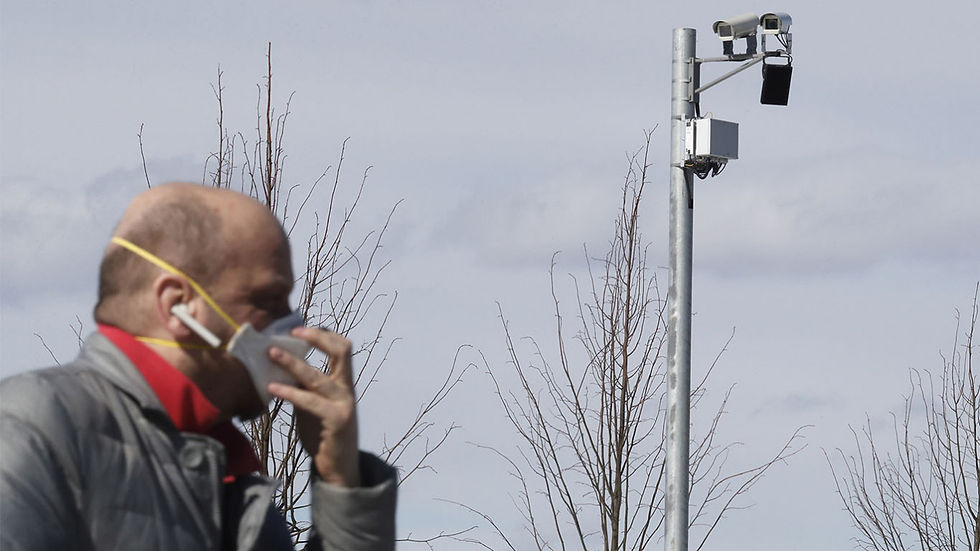
A particular threat to democracy comes from the use of technology in order to monitor and control populations. This was widely witnessed during the health crisis in authoritarian regimes such as China and South Korea. In China, monitors installed throughout major cities logged the movement and temperature of its inhabitants, telephones, rail and flight data were collected to track down people. In South Korea, CCTV and credit card data were used to track people's whereabouts.
Authoritarian regimes in Asia, notably in South East Asia have appeared to be more successful at containing the corona virus, whereas Europe for instance was caught unprepared. Indeed, the autocratic methods of surveilling and containing populations has proved to be effective to curb the virus.
It is crucial that as artificial intelligence knowledge in surveillance develop, that Western democracies do not lose sight of the paramount importance of human rights and individual liberties. During the crisis, Russia has increased the surveillance of its population dramatically, and turning back from these advancements will likely be impossible.
In the UK for instance, the NHS has introduced the Track and Trace app. The app is meant to alert its user if they are in close contact with somebody who also has the app and is known to have tested positive for the corona virus. The NHS claims data on the identification and location of the app users is not saved nor is it used. It is necessary that the UK does not take advantage of the possibility of collecting data for monitoring purposes, to protect the future of democracy.
Tying it all Together
The way our governments choose to face this health crisis will have a great impact on the protection of people's rights and of democracy. Indeed, the way we react to this crisis may have long term consequences and measures employed with a view to limit the spread of the virus today may still be used in the future. For these reasons, it is crucial that governments be wary of overly restrictive measures with incomplete scientific proof of efficacy and of the use of surveillance tools.


Comments